
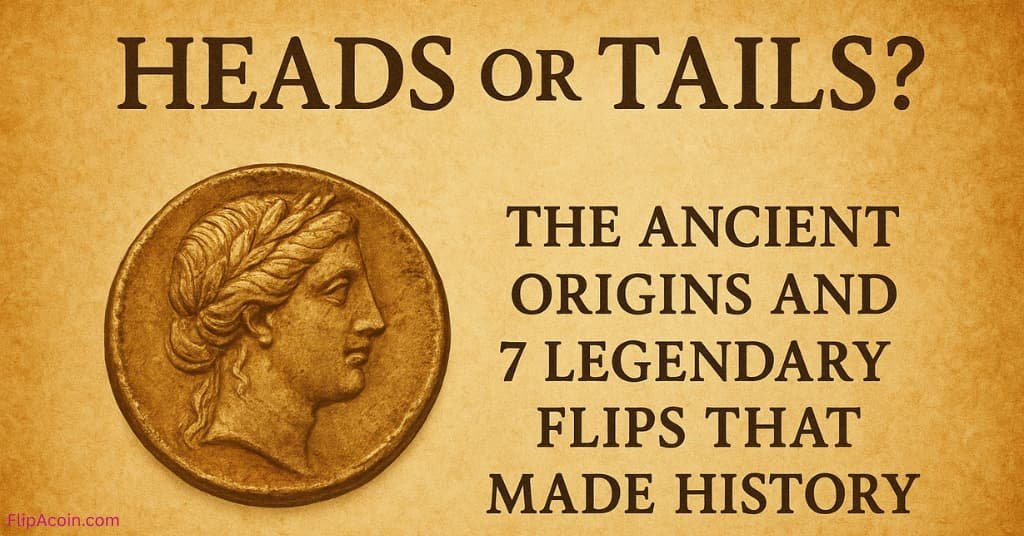
The classic coin toss. One of the oldest, simplest, and most universal of all human decision-making methods. Everyone has experienced it–standing with a friend, a coin balancing on a thumb, deciding who buys the coffee, who gets the last slice of pizza, or which movie to watch. A coin flip is an opportunity for unfiltered, pure chance in our lives.
But, have you ever wondered where this comes from? Why do we trust a piece of metal to make a fair decision? And, has a mere coin flip ever really mattered?
The answer is yes. From the founding of cities to the fate of empires and billion dollar companies, the 50% chance a coin provides has changed the course of history on some incredible occasions. So let’s explore the history of coin flipping and review some instances where a flip of the coin changed the world.
The Ancient Origins of the Coin Flip
The act to flip a coin is far older than the coins we use today. Before standardized currency, people would use shells, animal bones, or sticks to divine the will of the gods or make impartial judgments. The principle was always binary: yes or no, win or lose, this or that.
The term “heads or tails” itself has a curious history. In ancient Rome, coins didn’t feature the profiles of emperors; they were stamped with gods and military standards. The Romans had a practice called “navia aut caput” (“ship or head”), referring to the common imagery on their coins. As coinage evolved throughout Europe, monarchs and rulers placed their heads (or busts) on one side, making “heads” the standard term. “Tails” simply refers to the opposite side—the tail end of the coin.
The fairness of a coin flip lies in its physics. When spun in the air, a coin behaves like a tiny gyroscope, making its landing genuinely unpredictable, assuming it’s flipped correctly. This element of true randomness is what has given the coin flip its enduring power as a tool for fairness.
From Medieval Mischief to Modern Mayhem: The Evolution of the Coin Flip
Let’s move on to the 18th century, and flipping coins has become a worldwide phenomenon. It was a method used by sailors on ships to share out the rum; it was a game of chance in smoky bars that made gamblers win and lose their fortunes by just one spin. The next century saw the practice invade sports—imagine cricket team skippers calling heads before the match. To add to it, even in the Victorian times, the British were flipping coins on the occasions like marriage toasts or deciding who pays the bill at the pub.
The 20th century? This was when the coin flip reached the heights of popularity. Different sports leagues established it; it was used for NFL kickoffs, soccer ties, and so forth. In 1958 it was the sole reason for introducing overtime (we’ll discuss that later). The coin flip was also used in the popular culture—films of the 1930s featured Hollywood gangsters like George Raft flipping silver dollars for the sake of having more dramatic scenes, one of these movies being Scarface. And I can’t forget the cartoons: Bugs Bunny imitating Raft with a “What’s up, doc?” while the coin is spinning.
Nowadays, one can see and hear about coin flips everywhere. Tech savvy people use coin flip apps; still, the real thing is unbeatable—the flick off your thumb, the tumble in the air, and the breathless pause. According to statistics, 89% of the official tosses that are done worldwide still follow the “heads or tails” method because of that very fairness. The $1 coin in Australia is good at carrying the tradition: a portrait of the Queen on heads, and the image of dancing kangaroos on tails. It shows that, no matter how sophisticated our world may be, sometimes, you simply have to flip a coin and accept whatever happens.
But here comes the twist: Could it be that the casual coin flip was not only a way of deciding where to go for dinner? That it could be such a decisive factor that it would lead to the birth of legends, the fall of kings, or the alteration of maps? Let’s take a closer look at seven occasions when history depended on a simple flip. These are not just legends; they are real incidents when fate was in control. Get ready to be astonished.
7 Coin Flips That Flipped the Script on History
1. The Flip That Named a City (Portland, Oregon, 1845)
Welcome to Oregon in the 1840’s—oxen carts, gold fever, and no Yelp. Two pioneers, Asa Lovejoy from Boston and Francis Pettygrove from Portland, Maine, find a great location on the Willamette River and need to decide on a name: Boston or Portland? No gun fight, no battles; these men gracefully flipped a coin, a best of three with a copper penny filled with meaning. Pettygrove chose the tails (his side’s coin from Maine), and on two flips, tails won. Voila: Portland, Oregon.
That penny? Not in some dusty box; it is on display in the Oregon Historical Society. It is a shiny expression of how one coin flip placed “Portland” on the map that night. If it were not for that moment, we’d perhaps be drinking out of growlers of Boston-beer-in-River. One flip, one city—seriously, that’s some stakes.
2. The Flip That Got Us off the Ground (Wright Brothers, 1903)
The date was December 17, 1903: Kitty Hawk, North Carolina. The wind was blowing hard from the sea and the Wright brothers—Wilbur and Orville—were working on their flimsy flying machine. It was a make or break situation for air travel, but who would be the first to fly? A long argument between the two brothers ended with a coin toss. Wilbur called heads and got lucky… but when it was his turn, a strong wind blew the plane down. Then, Orville took his turn and got it right: 12 seconds, 120 feet—the beginning of flying.
Some historians claim that it was Orville’s luck that saved him on that day, but the main thing was that the coin toss opened the skies. No toss, no Orville’s victory—no airplanes, no SpaceX. Wilbur later made a remark that it was the most significant toss in history. Overstatement of the century.
3. The Flip That Doomed a Rock Legend (Ritchie Valens, 1959)
Rock ‘n’ roll’s golden age: Guitars wailing, crowds screaming. Young star Ritchie Valens—”La Bamba” guy—is touring with Buddy Holly and The Big Bopper. Seats on the next flight are scarce; guitarist Tommy Allsup offers his spot to Ritchie. But Ritchie flips a coin with him for it. Heads: He takes the plane. It lands heads.
Tragedy strikes hours later: The chartered Beechcraft crashes in a snowy Iowa field, killing all aboard—Holly, Valens, The Bopper. “The Day the Music Died,” as Don McLean sang. That fateful flip coin silenced a voice at 17, birthing a ballad that defined a generation’s grief. Chilling reminder: Sometimes, fate’s whisper is a coin’s clatter.
4. The Flip That Crowned Soccer Champions (Euro 1968 Semifinal, 1968)
The beautiful game of soccer turns ugly in extra time: Italy vs. Soviet Union, a 0-0 deadlock in the European Championship semi finals. Still no penalties—they’ll fix that down the road. The ref pulls a coin to quickly decide the winner—one coin toss to determine the fate of the teams. Italy calls “heads,” and it flips heads. They get to advance to the final, where they defeat Yugoslavia and claim their glory.
Puerto Rico almost pulled off the same thing in the 1968 Olympics in basketball against the US. The game was tied, a coin toss was used to decide the winner, and Uncle Sam got the gold. But the coin flip in the EURO? It evoked outrage in soccer, which led to implementing penalties around the world. In one coin flip, the sport metamorphized overnight; no longer would golden opportunities depend on a coin toss with Lady Luck.
5. The Flip That Invented Football Overtime (NFL Championship, 1958)
Municipal Stadium in Baltimore was a cold place to be on December 28, 1958. The Colts and Giants tied at 17-17 in the final match for the NFL championship. Overtime rules were non existent? No worries—coin toss decides which team will take the ball for sudden death. The Colts’ Gino Marchetti goes for the heads; it turns out heads. Johnny Unitas takes the challenge and runs for 80 yards scoring a touchdown in 2:07. The Colts celebrate their victory over the Giants by a score of 23-17 in the very first televised overtime—73 million people were watching.
The game was given the nickname “The Greatest Game Ever Played,” which it very much resembled as it changed the very nature of football from a slow grind with ties to one with thrilling finishes that kept the spectators on the edge of their seats. It was the flip of a coin to determine the winner of the modern OT rules? It might have happened that way because without the coin toss, Super Bowl games might still have to end in draws. Thank the gridiron gods for that crucial toss.
6. The Flip That Bred a Racing Legend (Secretariat, 1973)
Thoroughbred heaven: Penny Chenery, “The First Lady of Racing,” partners with oil tycoon Claiborne Farm to syndicate her star foal. Stakes are high—$190,000 per share. To split even and odd shares fairly, they flip coin. Chenery wins heads, snags the evens—including foal #666, later named Secretariat.
“Big Red” storms to the Triple Crown, shattering records (like 31 lengths at Belmont). Without that flip, Claiborne gets the champ; racing history dulls. Chenery’s tale? Immortalized in Secretariat the movie. One spin, one dynasty—equine excellence on a dime.
7. The Flip That (Allegedly) Launched a War (Iraq Invasion, 2003)
Desert Storm 2.0: Having successfully plotted the invasion of Iraq in his head, the pivotal question for US General Tommy Franks was whether to conduct a north vs south invasion. Logistics screamed south, while intelligence reports were whispering north. So the story goes, Franks flipped a coin; “heads” was for a southern invasion. It came up heads. Troops were inserted from Kuwait and, within weeks, were able to topple Saddam.
Historians debated the legitimacy of the story (in fact, Franks later commented it was a “gut call”), but the story persisted: a man’s decision paving the way for conflict that radically altered the Middle East and ultimately cost trillions of dollars and thousands of lives. Ironic, no? A tool for picking teams on the playground made a world changing decision in the game of global chess. The folly of war served cold.
Wrapping It Up: Your Turn to Flip the Script
Whew, what a ride. From Roman ships cutting waves to Secretariat pounding tracks, the lowly coin flip demonstrates small things create giant waves. It’s not randomness; it’s humility, a nod that we don’t always control things. The next time life’s throwing you curveballs, pick up a quarter, flip it, and let heads or tails impart wisdom.
What’s the wildest coin flip story you’ve got? Share it in the comments—did it get you a job, a date, or a tattoo disaster? If this post flipped your brain, show it to a friend who’s flip coin averse. Until then, keep spinning those choices. Heads up